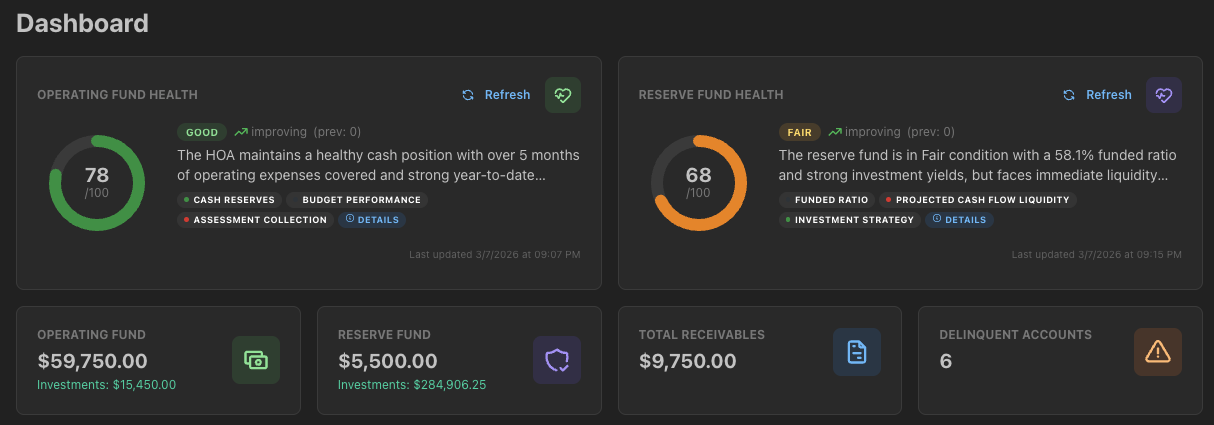
Somewhere in your community's bank records, there's a reserve fund balance. Maybe it's $180,000. Maybe it's $650,000. Whatever the number, there's a good chance most of it is sitting in a standard checking or savings account — the same kind of account you might use for your personal grocery money — earning somewhere between 0.01% and 0.50% annually.
Meanwhile, certificates of deposit at FDIC-insured banks are paying 4% or better on terms as short as three months. The math on the difference isn't subtle. A $400,000 reserve fund earning 0.10% generates $400 a year in interest income. That same fund in a thoughtfully structured CD ladder earning an average of 4.5% generates $18,000 — every year — without taking on any meaningful risk and without locking up funds the community might need.
The reason most HOA boards don't capture this income isn't ignorance. It's uncertainty. Treasurers know the reserve fund exists to pay for capital projects, and they're understandably nervous about committing funds to instruments with fixed maturity dates when project timing is hard to predict. What if a roof fails early? What if the board decides to accelerate the parking lot? The precautionary answer — keep everything liquid — is safe but costly.
CD laddering is the strategy that resolves this tension. It preserves liquidity by staggering maturity dates across multiple instruments, so something is always becoming available, while capturing yields that a simple savings account can't touch. And for HOA reserve funds — which have long time horizons, predictable (if sometimes approximate) spending schedules, and no tolerance for investment risk — it's close to the ideal approach.
Why Reserve Fund Yield Matters More Than Most Boards Realize
There's a tendency to treat investment income on reserve funds as a nice bonus — something that happens in the background and occasionally shows up as a pleasant line item on the monthly report. In reality, it's a meaningful contributor to reserve fund health, and ignoring it has compounding consequences over time.
Consider two communities, each with $350,000 in reserves today, each contributing $4,000 per month. Community A keeps everything in a savings account earning 0.25%. Community B maintains a CD ladder earning an average of 4.25%. Over five years, the difference in interest income is roughly $68,000 — money that Community B can put toward capital projects, reducing the contribution rate increase needed in the next budget cycle, or simply building a larger cushion against unexpected costs.
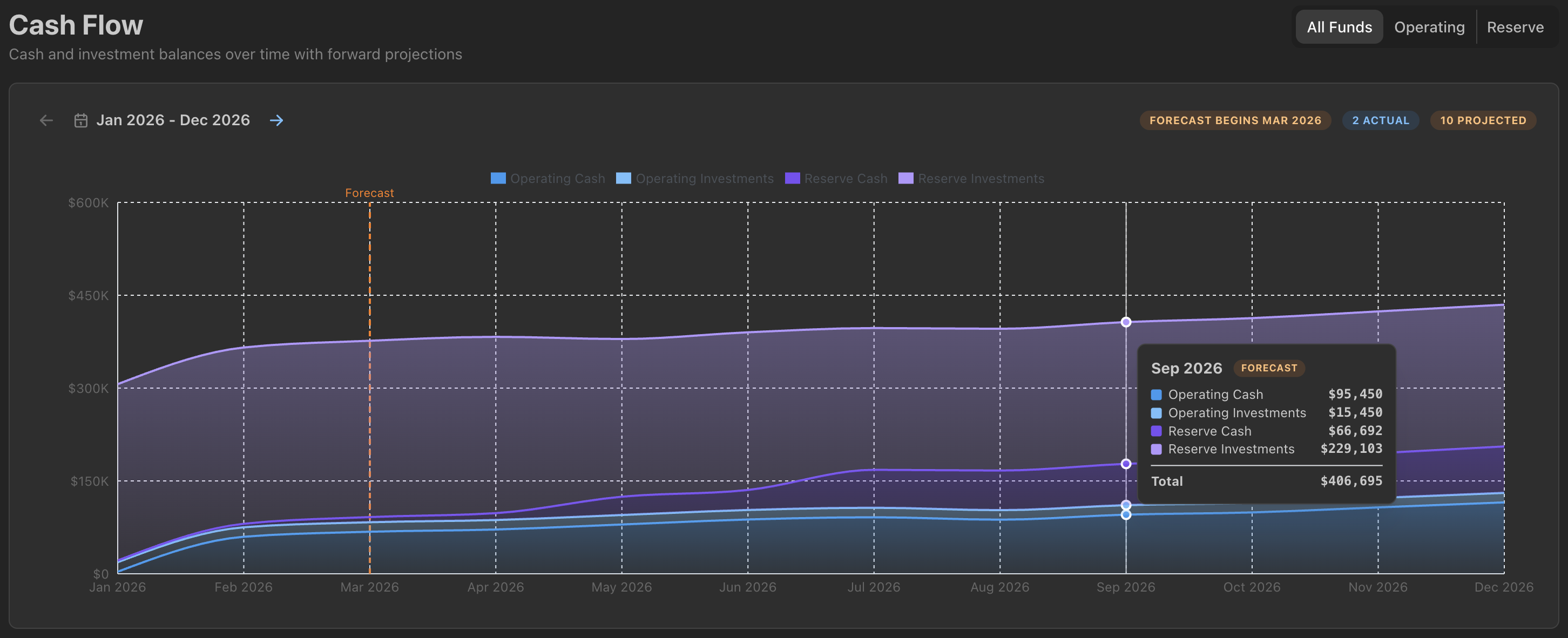
That gap has another implication that's less obvious but equally important: reserve fund health scores are forward-looking calculations that include projected investment income. A fund earning 4% annually on its balance is on track to fund its capital needs at a lower contribution rate than a fund earning 0.25% on the same balance. In other words, better investment management can directly reduce the assessment increases homeowners face — or provide the additional margin that prevents a future special assessment.
The compounding reality: Investment income on reserve funds isn't a rounding error. Over a 5- to 10-year horizon, the difference between idle cash and a properly laddered CD portfolio can easily exceed $50,000–$100,000 for a mid-size community — enough to meaningfully affect the reserve fund health score and the contribution rate required to maintain it.
What CD Laddering Is (And Why It Fits HOAs So Well)
A CD ladder is a portfolio of certificates of deposit with staggered maturity dates. Instead of putting all your available funds into a single 12-month CD and hoping nothing comes up before it matures, you divide the funds across multiple CDs with different terms — say, 3 months, 6 months, 9 months, 12 months, and 18 months. As each CD matures, you either spend the funds if they're needed for a project, or roll them into a new CD at the long end of the ladder.
The result is a structure where some portion of your reserve fund is always approaching maturity. If an urgent capital need arises, there's a CD coming due within a few months at most. If no projects are imminent, maturing CDs roll into new longer-term instruments, maintaining the yield. The ladder is self-renewing and continuously liquid in a practical sense — not liquid like a checking account, but liquid in the way that matters for capital project planning.
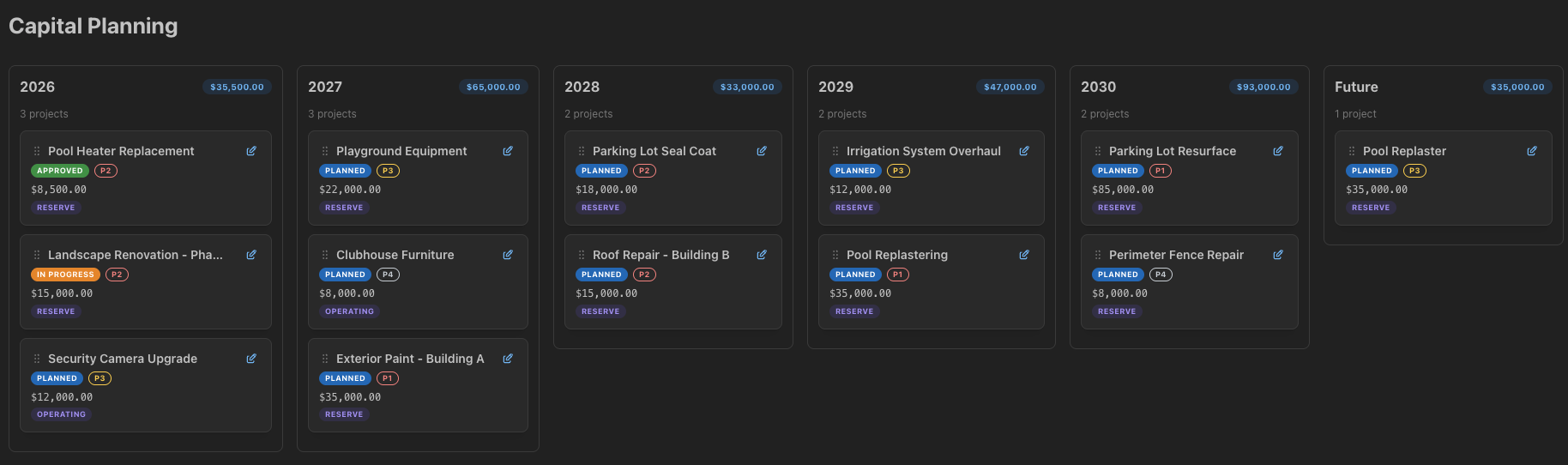
This structure maps onto HOA reserve fund dynamics unusually well for several reasons. First, reserve fund spending isn't random — it follows a capital project schedule with known (if sometimes approximate) timing. Second, the amounts involved are large enough that even modest yield improvements generate material income. Third, HOA reserve funds have an implicit multi-year time horizon, making longer CD terms readily available for the bulk of the portfolio. And fourth, FDIC insurance covers CD balances at insured institutions up to $250,000 per depositor per institution, making it possible to protect large reserve balances by distributing across multiple banks.
"We had $380,000 in reserves sitting in our operating bank's savings account earning almost nothing. Our treasurer built a five-rung ladder and we went from earning maybe $600 a year to over $16,000. That's basically a free parking lot reseal every five years just from interest income we were leaving on the table."